
First Phone License Research report
The Preparation Gap
State of the First Phone 2026
Explore the research on first smartphones, family screen rules, and digital readiness. Download First Phone License’s free six-page Preparation Gap report.
01
In brief
A first phone brings responsibilities that a birthday or a set of rules cannot prepare a child for on its own. This report explores the space between planning for a phone and preparing for life with one—and what published research suggests families can do.
It is a synthesis of published research, written for parents who want a calm, practical path and for journalists who need a clear, citable summary with its limits stated up front.
02
What the research says
Each finding links to its published source so you can check the original.
Parents’ expectations and ownership do not always align.
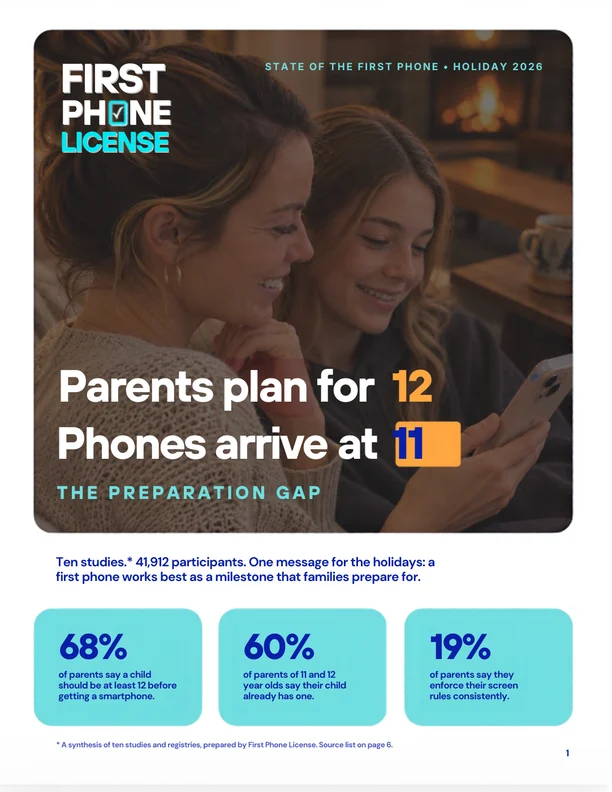
In Pew Research Center’s 2025 survey of U.S. parents of children 12 and younger, 68% said a child should be at least 12 before having a smartphone. Yet 60% of parents of 11- and 12-year-olds said their child had one. These age-group snapshots do not track individual families changing their plans.
Source: Pew Research Center, 2025 · parent survey (opens in a new tab)Having rules is different from keeping them.
Among surveyed parents of children 12 and younger, 86% reported screen rules, while 19% said they stuck to them all the time and 55% most of the time. The percentages describe all surveyed parents, not only those with rules.
Source: Pew Research Center, 2025 · parent survey (opens in a new tab)Privacy skills can be taught and practiced.
Two online experiments with children ages 9–13 (214 and 366 participants) found that privacy-literacy training improved understanding of data practices and privacy-protective disclosure behavior. These findings concern particular learning activities and outcomes—not every kind of online risk.
Source: Desimpelaere, Hudders & Van de Sompel, 2020 · experiments (opens in a new tab)A written plan alone may not change behavior.
A randomized trial involving 1,520 parent-adolescent pairs found that completing a family media-use plan did not produce a statistically significant change in adolescents’ media-rule engagement. That does not mean agreements have no value or that all family approaches have been tested.
Source: Moreno et al., 2021 · randomized clinical trial (opens in a new tab)Age alone does not settle the readiness question.
A five-year prospective study of 263 low-income Latinx children found no statistically significant associations between mobile-phone ownership or acquisition age and the measured depression, sleep, or grade outcomes. Other observational evidence discussed in the report links earlier ownership with lower well-being. Different samples and methods limit direct comparisons; association does not establish causation.
Source: Sun et al., 2023 · longitudinal cohort; see report for contrasting studies (opens in a new tab)Families are coordinating the decision together.
The report cites more than 155,000 families in the Wait Until 8th pledge registry in 2026. This is a separate advocacy-registry count—not study participants or evidence that taking the pledge causes better outcomes. The organization’s current website describes the count as parents.
Source: Wait Until 8th · registry cited in the 2026 report (opens in a new tab)
03
What this report is, and is not
Read this before citing a number.
- A synthesis, not a new study
- This is a synthesis of published research. It is not a new trial and not a statistical meta-analysis.
- 41,912 participants, combined by the report
- The figure adds participants across different studies as reported. They were not independently deduplicated, so some people may be counted more than once.
- 155,000+ pledge families are a separate figure
- The report cites this 2026 advocacy-registry count separately. It is not a research sample and is not part of the 41,912; the organization’s website describes its current count as parents.
- Associations, not causation
- Most cited findings describe associations. The trials ran in different settings, so there is no universal comparison, and none of it is proof that First Phone License works.
04
For families: skills before screens
Give the phone a job.
Introduce it as a household tool with a purpose, rather than an unrestricted personal gift.
Practice before the first unlock.
Rehearse a real situation together, such as an unkind group chat or an unexpected request for personal information.
Agree on a calm response.
Make it safe for your child to ask for help when something goes wrong online.
Coordinate with other families.
Talk with parents you know about timing, expectations, and ways to reduce peer pressure.
Wondering where your own child stands?
Take the free readiness assessment05
For journalists
Suggested citation
First Phone License. (2026). The Preparation Gap: State of the First Phone 2026. https://firstphonelicense.com/preparation-gap
Media contact
press@firstphonelicense.comInterview requests, clarifications on methodology, and the cover image for publication.
06
Questions
What is the preparation gap?
It is the gap between planning for a child’s first smartphone and preparing for its everyday responsibilities. The report brings together research on ownership, screen rules, privacy learning, and readiness to help families plan a more gradual introduction.
Is this new research by First Phone License?
No. This is First Phone License’s synthesis of existing research and registry information, not a new clinical trial or a statistical meta-analysis. Its reported total of 41,912 participants combines different studies; it is not one sample and has not been independently deduplicated. The separate 155,000+ pledge figure is not included as study participants.
What age should a child get a smartphone?
The report does not establish a universally safe age. It recommends considering demonstrated responsibility, judgment, self-regulation, family circumstances, and adult support alongside age. Observational associations cannot tell us that a particular acquisition age causes a particular outcome.
Does the research prove the Learner’s Permit works?
No. The studies reviewed tested other interventions or observed other populations. They inform the emphasis on preparation and practice, but they are not an evaluation of First Phone License or its Learner’s Permit course.
Is the report free to download?
Yes. The full six-page PDF is free, approximately 3.4 MB, and requires no email address or account. You can download it or open it in your browser.
What if my child already has a phone?
You can still begin a graduated approach: clarify the phone’s purpose, practice difficult situations together, agree on a calm way to ask for help, and revisit access as your child demonstrates readiness.
07
Sources
- Pew Research Center (2025): How parents describe their kids’ tech use (opens in a new tab)
U.S. parent-reported smartphone ownership and preferred starting ages.
- Pew Research Center (2025): How parents approach their kids’ screen time (opens in a new tab)
Household rules and self-reported consistency.
- Desimpelaere et al. (2020): Knowledge as a strategy for privacy protection (opens in a new tab)
Two experiments on privacy literacy and children’s disclosure behavior.
- Moreno et al. (2021): Effect of a Family Media Use Plan on Media Rule Engagement (opens in a new tab)
Randomized clinical trial published in JAMA Pediatrics.
- Sun et al. (2023): Mobile phone ownership, acquisition age, and child adjustment (opens in a new tab)
Five-year prospective study published in Child Development.
- Wait Until 8th: the pledge (opens in a new tab)
Advocacy registry; distinct from the research participant total.
Keep a copy of The Preparation Gap
State of the First Phone 2026. Free to read, share and cite.